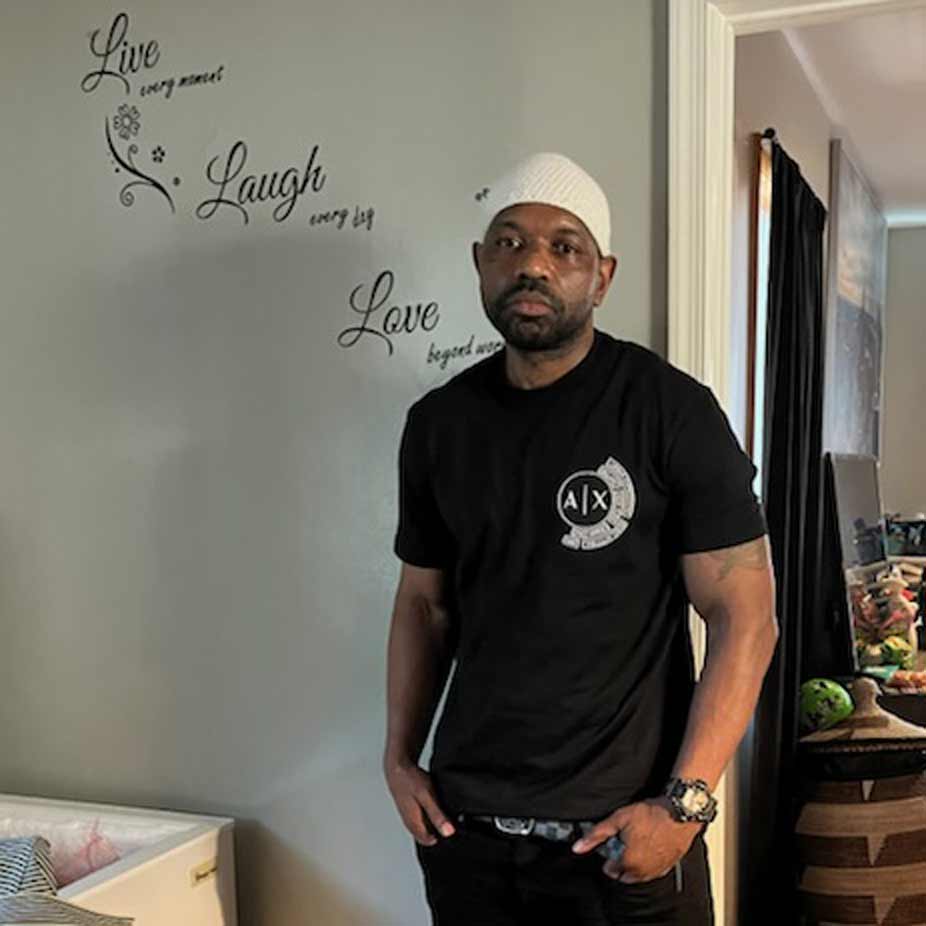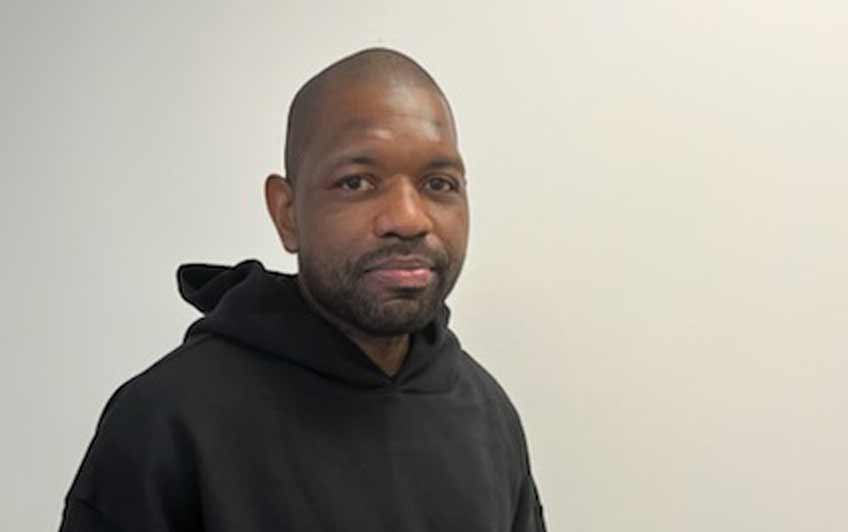
“My support cast wasn’t as strong as… people in there thought it was,” says David Jones. “It was just my willpower and my drive.”
That drive is the engine that has propelled David his entire life. It carried him through a childhood in Northeast Washington DC, where he learned early to distinguish between “a house and a home.” A house, he explains, is just a structure. A home is a place with “people in there that’s loving and the things… to make you feel loved and cared for.”
“I grew up in a house,” he says.
He describes a childhood marked by poverty, of going to bed hungry and waking up hungry, of learning to fend for himself because he had no other choice. “I never had that,” he says of a reliable support system. “I always… had to go out and fend for myself and that’s how I feel to this day.” This fierce self-reliance created a misconception when David was incarcerated. Other men saw his focus and assumed he was “well taken care of” by people on the outside. He had to set them straight. “No, I’m in the same predicament you’re in,” he would explain.
He saw the system’s failures up close, particularly the lack of opportunity. “The biggest misconception is that you can go in there and do your time and then you just come home,” David says. “No, that… doesn’t work that way. It’s a lot of roadblocks. One of the biggest roadblocks at his facility was the absence of programming. “The jail didn’t offer programs,” he states flatly. For a man defined by his drive, idle time was a dangerous thing.
True to character, David decided to find his own opportunities. “I just sat there and I tried to think about the betterment of myself,” he recalls. He asked around about educational programs available to incarcerated people, and Level was at the top of the list. He immediately contacted his attorney and sponsor, Yared, with a clear directive: “Let’s get the ball rolling now.”
Yared enrolled him, and the program’s format proved a perfect fit for David, a “hands-on individual” who finds it “hard… to sit still for a long time.” A “big old book,” he says, would take him forever to grasp. Level’s guides were different. “It don’t over do it… It’s compact enough,” he explains. “It gives out enough information and it takes enough time to do… I know that even other individuals can grasp these things.”
This accessible, achievement-oriented structure made him eager for more. “That makes any individual want to go on to the next one,” he says. “I wrote and reached out… like, Where’s the next one?” The impact was immediate and profound, going far beyond just filling time. “I gain something from all of the guides because I didn’t know about a lot of stuff that was written in a lot of them,” he says. Most importantly, the guides provided critical focus. “Level supported me,” David states. The program “helped me get through days where… I had a bad train of thought. I was able to complete Level’s guides to keep me from getting sidetracked.”
Then, that programming became the literal key to his freedom.
Those certificates helped me to get out. That was a big part of my release. By me reaching out to Level… that showed the court that I was programming… Just think about it, Level had like 8 to nine 10 courses that I completed. That was 8 to nine 10 things that I was into outside of being in trouble. And the judge looked at that.
– David Jones, used Level in a federal prison
“Those certificates helped me to get out. That was a big part of my release,” he reveals. With his motion for release pending, the certificates proved he was actively working toward his betterment, even when his facility offered nothing. “By me reaching out to Level… that showed the court that I was programming… Just think about it, Level had like 8 to nine 10 courses that I completed. That was 8 to nine 10 things that I was into outside of being in trouble. And the judge looked at that.”
Now released, David is applying that same drive to building his future. He’s navigating a newly gentrified DC, a city where the $50 in gate money he was given barely covered his $39 Uber ride home, leaving him $11 to restart his life. But he has a plan. He is leaning on the knowledge he gained, particularly from Level’s guides on business and financial literacy. He even brought one home with him. “It was dealing with the credit stuff,” he says. “It actually taught me how to go about the credit card stuff… that I didn’t know about.”
His goal is to move to Houston and start his own business or work with a friend in construction or demolition. “I’m still a man of business,” he says, reflecting on the entrepreneurship guides. “All of them teach you about gaining something and granting something of your own. So that’s what I took out of it.”
For David, Level wasn’t just a program that offered certificates. It was, he says, “a platform… to receive or to achieve something greater in life.”