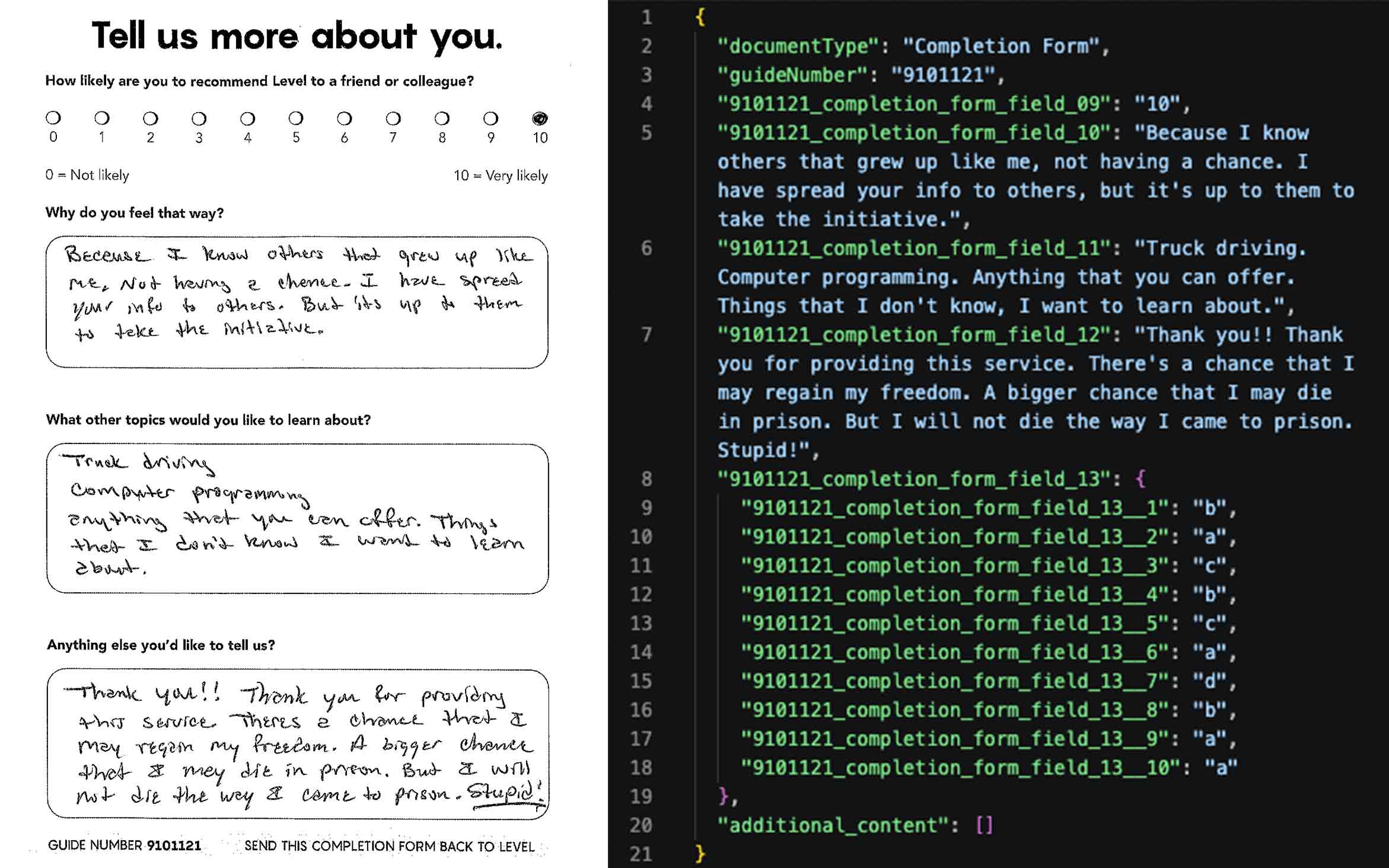
Level Digitizes Thousands Of Handwritten Paper Forms From People In Prison
The reality on the inside
For people in prison, handwritten paper forms and correspondence is still the default. Yes, there are tablets that allow for watching videos and sending some correspondence to select recipients. There are pay phones in common areas. For some people at some facilities, there is limited access to computer labs. Paper and pen still dominate as the lowest barrier, most universal way to reach people in prison, especially those on higher security.
Paper forms powered a correspondence education program
Level started a correspondence education program in 2020 that delivered educational and workforce development modules to people in prison across the country. This program grew to deliver over 17,800 educational modules directly to more than 7,000 incarcerated learners at 1,075 state, county, federal and military prisons in all 50 states. It also generated a huge number of handwritten paper completion forms – over 11,100! Transcribing these forms so that program data could be captured was a monumental task.
We built a remote online volunteer program that allowed volunteers to transcribe the handwriting and bubble answers from scans of paper completion forms. Volunteers enjoyed the process – especially the positive attitudes from learners and the ability to do the volunteer work from home, anytime. But the volume of completion forms was overwhelming! We eventually grew to a queue of more than 4,000 completion forms awaiting volunteer transcription.
AI handwriting recognition provided a solution
Last year, the team at Level began investigating whether AI handwriting recognition could help. We explored methods from big providers like Google and Amazon, but the complexity and cost of implementation was a no-go. Then, we discovered DocuPipe, an AI-powered document intelligence service. We found that we could send a scan of a completion form to DocuPipe through a background computer-to-computer service called an API and receive back a structured, organized, digital transcription that recognized handwriting and bubble answers. In simple terms, our computers could send their computers a scan and get back a transcription. And the best part? It took about 20 seconds and cost in the neighborhood of 15 cents for a multi-page handwritten form!
We thoroughly tested the process. Was the handwriting recognition accurate, especially for cases where people write even outside the bounds, sometimes using light pencil, scratching things out? Was the transcription of bubble answers accurate, especially considering cases where learners Xed out bubbles or made other marks? To our amazement, the answer was a resounding “Yes!”
We did find some mistakes, and the team at DocuPipe helped work through fixes for some of the generalized issues. We also know that human transcribers make mistakes, so we were looking for results that met or exceeded how our volunteers worked. The results from DocuPipe exceeded our expectations for accuracy. Combined with the quick turnaround and low cost, using DocuPipe to transcribe our completion forms became a no-brainer.
Level sends us some of the hardest handwriting we see: light pencil, answers written outside the boxes, bubbles crossed out and marked again, pages folded and torn in the mail. The team at Level checked our results closely and told us exactly when we got something wrong, and customers like that make a product better. We build this software for all kinds of businesses, and it means a lot to us that it also helps someone with only paper and a pencil be heard.
– Nitai Dean, co-founder of DocuPipe
We began delivering all the new handwritten paper forms to DocuPipe and built a system for human-in-the-loop review by staff and volunteers. We even began processing that long backlog! To date, DocuPipe has transcribed over 5,300 multi-page handwritten educational completion forms from people in prison. Privacy is protected as all forms are deleted from DocuPipe once they are transcribed. The only place where the transcribed data is stored is in our own database, just how it was with volunteers doing the transcription.
Read a detailed case study on DocuPipe’s website.
Opening the door to a new program
Once we saw that we could get immediate digitized versions of handwritten paper completion forms, we asked what else we could do. People in prison and their supporters on the outside were asking for more personalized programming and for support with reentry and career development. We spent most of 2026 building a new AI powered reentry and career support tool that we call Carmen that takes advantage of the handwriting transcription from DocuPipe. Carmen was developed with support from Jobs for the Future’s Entrepreneur-in-Residence cohort on AI, Future of Work and User-Informed Design. In the coming weeks, we’ll release more information about how Carmen works and the ways that community aligned AI applications help people thrive.
Advanced technology helps serve those with little access to technology
At Level, we have always believed in providing people with low-barrier products that increase access, especially for the hardest to reach. We can reach people in solitary confinement in some of the most restricted environments in America. While it’s a bit counterintuitive, we have seen time and time again that well applied, advanced technology helps make this happen. Advanced AI-powered handwriting recognition allows Level to reach more people in more restricted environments, meeting people where they are, using what they have available. Which often is no more than paper and a pencil.