Level launched its sponsorship program in December 2024, for the first time allowing families and supporters on the outside to enroll their incarcerated loved ones in our education program for people in prison. To ensure we are building a program that truly serves our community, we conducted our first comprehensive sponsorship program survey in December 2025 in collaboration with Stand Together Foundation, using Customer First Measurement.
The survey was distributed in mid-December and we collected 159 total responses, representing a remarkable 32 percent response rate. Today, we are thrilled to release the full results. The insights we gathered highlight the profound impact of connection and the critical areas where we can grow.
The power of connection: what we heard
Across open-ended responses, sponsors presented a dual picture: deep gratitude for the mental and relational benefits the program provides, coupled with a strong desire for program expansion and logistical reliability. Sponsors generally view Level’s program as supporting their goal for their loved one to learn, grow and come home prepared to pursue a brighter future together.
You made my life better by being so timely and efficient in providing services. I knew that there was at least one resource we could depend on to be there for him.
– Survey participant and sponsor of an incarcerated loved one
Gaining skills for successful reentry
Sponsors most frequently identify success for their loved one as the acquisition of knowledge, new skills, and tangible achievements like certificates. Sponsors see their loved one’s educational accomplishments in Level’s program as indicators of personal growth and future utility. Sponsors are looking ahead to their loved one’s eventual transition back to society and view acquiring and developing skills and earning certificates as the functional tools required for employability and preventing recidivism.
For my daughter, it is making sure she keeps busy for her own sanity, but also continuing to keep her mind sharp. It is important to show that she is growing and making progress, that way when she goes in front of the parole board, they see that she is continuing to stay positive and ready to get out and be a successful member of society.
– Survey participant and sponsor of a loved one in prison
Mental health and peace of mind
Sponsors also equate success with the immediate mental and emotional benefits of the program, such as staying positive and avoiding institutionalization. Many sponsors reported that the program helps their loved one stay grounded and maintain a healthy attitude about their situation. Having something structured and future-focused to do helps maintain a healthy mind for the learner, which in turn comforts those supporting them on the outside.
My loved one has a very positive outlook on life and is excited about his future.
It does give me some peace of mind to know she has something to work on.
Turning feedback into action: what we’re doing
Since this survey closed in January and our team ran its initial analysis, we have made significant progress in addressing the two main needs expressed by our sponsors.
Expanding content offerings
Sponsors’ suggestions for improvement focused most heavily on expanding our content offerings. We saw a frequent request for more courses, a greater variety of topics, and specifically college-level content and technical training.
Historically, creating and publishing new content has been challenging from both a funding and production perspective. With the recent availability of customizable AI tools, however, we have been able to significantly reduce the cost and timeline for drafting and editing new content. By carefully vetting the sources we use and working closely with our subject matter experts throughout the process, we have reduced costs and shortened production timelines significantly while ensuring our content remains comprehensive, accurate and relevant to our audience.
Improving logistical reliability and communication
Logistical failures – specifically, the delay in turn-around time or outright non-receipt of materials – are primary triggers for sponsor distress, especially in the absence of proactive follow-up communication. An operational limitation of our program is that once our mail is delivered to a facility, we have no direct control over when, how, or whether it is ultimately given to the recipient.
We recognize that this systemic reality can be incredibly frustrating for families. To address this issue, we developed an automated protocol for preemptively verifying with new sponsors that our initial delivery to their loved one was received after three weeks. Implementing this protocol should not only reassure sponsors that our team is attentive to their loved one’s access to our program, but also quickly reveal the rare cases where we are unable to serve a learner so that a refund can be issued in a timely manner and organizational resources can remain focused on actively participating learners.
Moving forward, together
We believe that outcomes are improved when families, friends and other supporters on the outside are included in the educational advancement of people in prison. A massive thank you to the 159 sponsors who shared their voices with us. Your feedback is the foundation upon which we build a better program, and we are honored to partner with you in this vital work.
The full report is below, so keep reading to learn more.
In Their Own Words: The Impact and Value of Level’s Prison Education Program
2025-2026 sponsor survey
Executive summary
Level launched its sponsorship program in December 2024, for the first time allowing families and supporters on the outside to enroll their incarcerated loved ones in our education program for people in prison. Sponsors enroll through a form on our website and pay a fee to offset the costs of distributing our educational materials.
We conducted our first comprehensive sponsorship program survey in December 2025 in collaboration with Stand Together Foundation, using Customer First MeasurementTM. Customer First Measurement is a design principle for ensuring extant measurement tools like monitoring, evaluation and feedback are responsive to the people being served. We implemented Customer First Measurement because we wanted to mitigate institutional bias and generate results that reflect what truly matters most to our customers.
The survey opened on December 15, 2025 and closed on January 15, 2026. The survey included five quantitative questions (including three core Customer First Measurement metrics developed by Stand Together Foundation), four qualitative questions, and three demographic questions. All questions were optional and respondents were allowed to answer some or all according to their preferences.
The survey was distributed by text and email to 491 sponsors who had enrolled by December 15th, 2025. We offered a chance to win one of three $50 Visa gift cards, an enticement and appreciation for completing the survey. We collected 159 total responses, representing a 32 percent response rate.
On quantitative measures, sponsors indicated approval of Level’s program and the service they receive, with a sponsor’s length of time in the program correlating with an increase in ratings on all core Customer First Measurement metrics.
Across open-ended responses, sponsors presented a dual picture: deep gratitude for the mental and relational benefits the program provides, coupled with a strong desire for program expansion and logistical reliability. While many emphasized that the program successfully keeps their loved ones occupied, builds hope for reentry, and provides peace of mind, systemic mail barriers and a hunger for wider curriculum offerings represented the primary challenges.
What we heard and what we’re doing
For sponsors, there is a clear link between their loved one having a fruitful educational journey and making a successful transition after release. Sponsors view acquiring and developing skills and earning certificates as the functional tools required for future employability and preventing recidivism. Sponsors generally view Level’s program as supporting their goal for their loved one to learn, grow and come home prepared to pursue a brighter future together.
Since this survey closed in January and our team ran its initial analysis, we have made significant progress in addressing the two main needs expressed by our sponsors.
Sponsors’ suggestions for improvement focused most heavily on expanding our content offerings. Historically, creating and publishing new content has been challenging from both a funding and production perspective. Level prioritizes creating accurate, accessible, high quality educational content that is tailored to an audience of currently incarcerated learners. This has necessitated close coordination between subject matter experts (typically those who have experience with justice-involved communities), content writers who can properly align with Level’s pedagogical needs, graphic designers, and more.
With the recent availability of customizable AI tools, however, we have been able to significantly reduce the cost and timeline for drafting and editing new content. By carefully vetting the sources we use and working closely with our subject matter experts throughout the process, we have reduced costs and shortened production timelines significantly while ensuring our content remains comprehensive, accurate and relevant to our audience.
We also heard and addressed sponsors’ concerns about logistical reliability and communication. Logistical failures – specifically, the delay in turn-around time or outright non-receipt of materials – are primary triggers for sponsor distress, especially in the absence of proactive follow-up communication. Conversely, reliable material delivery directly facilitates feelings of hope and relational connection.
An operational limitation of our program is that once our mail is delivered to a facility, we have no direct control over when, how, or whether it is ultimately given to the recipient. Our system automatically notifies sponsors when content is shipped to their loved one, and some sponsors proactively notify us when some days or weeks pass and their loved one hasn’t received the expected material. This survey revealed, however, that many sponsors were not reaching out to us in those cases.
To address this issue, we developed an automated protocol for preemptively verifying with new sponsors that our initial delivery to their loved one was received after three weeks. Once a first delivery is successful, the chance of a future disruption in service is significantly reduced. Implementing this protocol should not only reassure sponsors that our team is attentive to their loved one’s access to our program, but also quickly reveal the rare cases where we are unable to serve a learner so that a refund can be issued in a timely manner and organizational resources can remain focused on actively participating learners.
Quantitative results
In addition to the three core Customer First Measurement metrics – Net Promoter Score (NPS), Net Transformation Score (NTS) and Net Empowerment Score (NES), all of which have a possible range from -100 to 100 – we also asked sponsors to identify the benefits they expected themselves and their loved ones to receive by participating in our program. (See Appendix for the full set of questions.)
Of the three scores, our NPS was the highest, indicating that a significant majority of sponsors would recommend our program to others. The other two scores, NES and NTS, were lower but still positive. The open-ended responses revealed that some sponsors found it confusing that we were asking about our program’s impact on them (as opposed to their loved one in prison), exemplified by this comment: “It just really has nothing to do with me. It’s totally for my loved one & helping him.” This suggests that, unless or until there are features of our program that target sponsors’ needs independently from their loved ones’ needs, metrics like NTS and NES and questions about benefits that sponsors experience directly may provide little utility in assessing the quality and impact of our program.
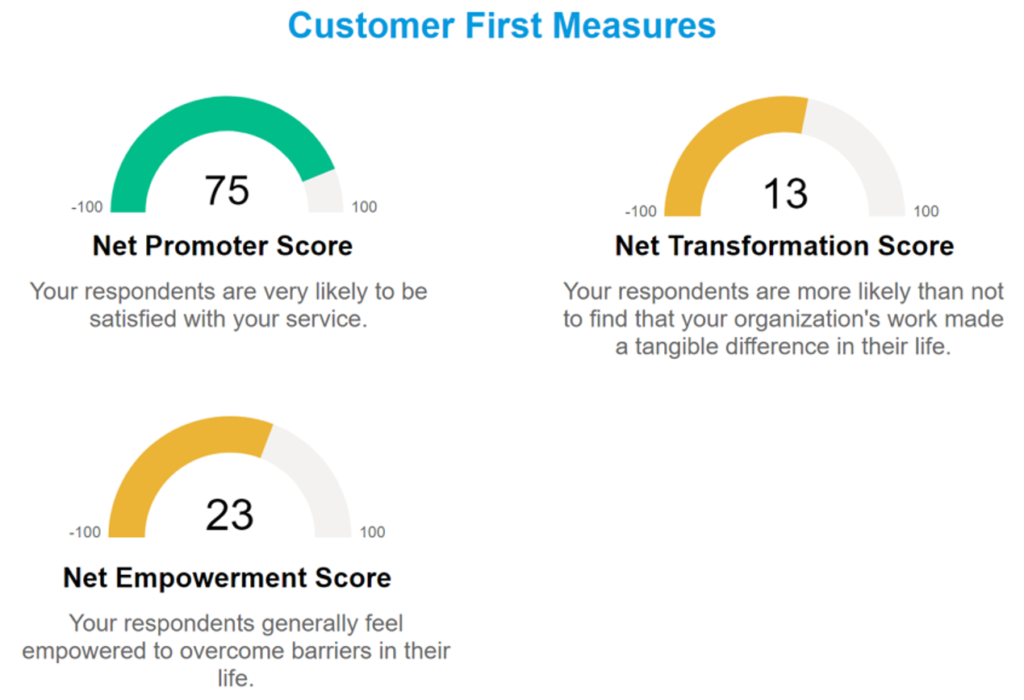
Customer First Measurement scores from all sponsors / survey respondents
We hypothesized that we would receive higher scores from more experienced sponsors whose loved one had participated in our program longer. Families and supporters of people in prison are accustomed to their needs being disregarded, not only by our carceral system but also by many of the entities that operate adjacent for-profit and not-for-profit services. For this reason, we expected sponsors who had experienced repeated cycles of service in our program and witnessed our team meet or exceed expectations to rate our program more highly. To test this hypothesis, we correlated responses with the number of educational modules their loved ones had completed.
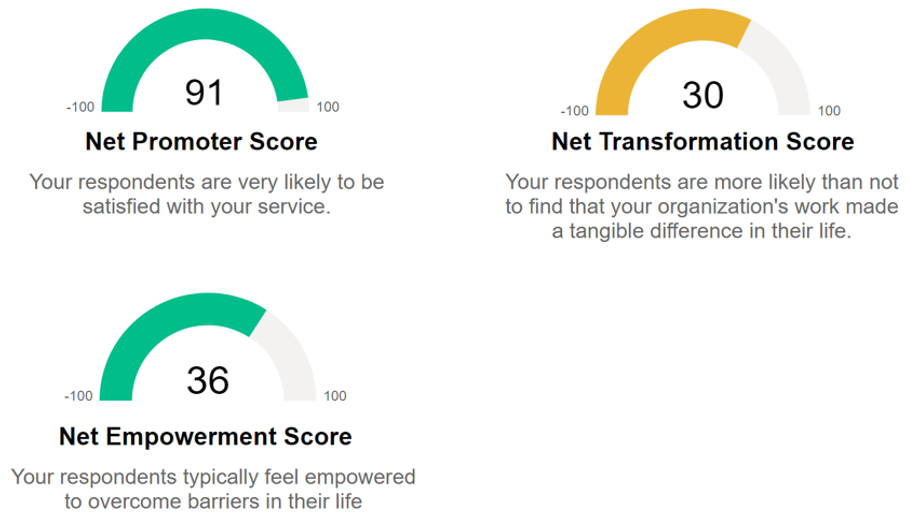
Customer First Measurement scores from 35 experienced sponsors whose loved one completed four or more educational modules
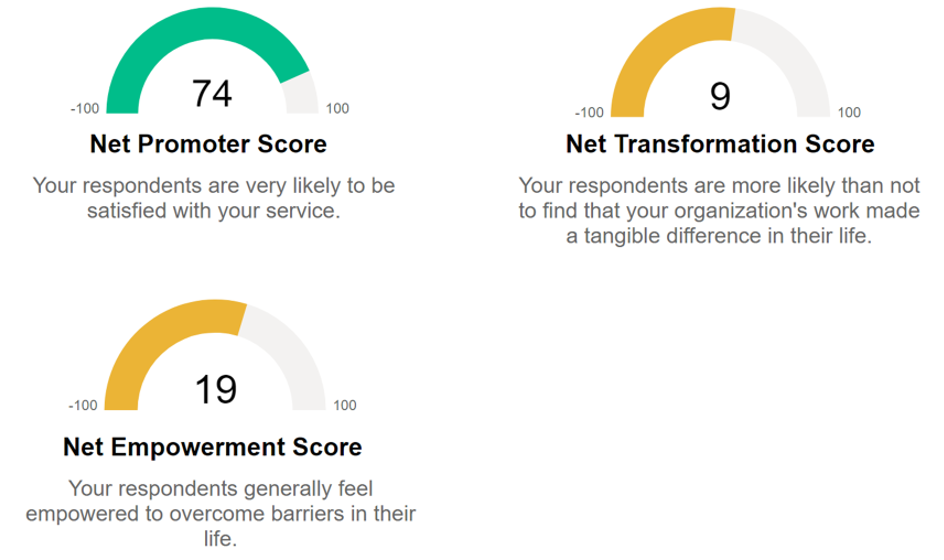
Customer First Measurement scores from 116 new sponsors whose loved one completed three or fewer educational modules
As shown above, our hypothesis was confirmed – all three Customer First Measurement metrics are higher for sponsors who have experienced more cycles of service in our program.
We also asked sponsors to identify the benefits they expected from our program, for both themself and their loved one. We drafted a list of potential expected benefits based on comments we had received from sponsors throughout the first year of the sponsorship program and included an option to select “other” and describe a benefit we didn’t define.
For their loved one, the top benefit expected by sponsors is “improved mental well-being,” followed closely by “time spent productively.” The third and fourth benefits most identified by sponsors are “certificates for activities towards rehabilitation” and “career exploration.”
For themselves, the top benefit expected by sponsors – by a significant margin – is “a positive thing to focus on with my loved one.” The second and third most frequently expected benefits are “investing in our shared future” and “connecting with my loved one,” respectively.
Qualitative results
We asked respondents three open-ended qualitative questions about how they would improve Level’s program and how they define success for themself and their loved one. (See Appendix for the full set of questions.) Below are the common themes that emerged across the responses.
“Learning new things” and gaining skills
42 responses | Positive
The most frequent theme identifies success as the acquisition of knowledge, new skills, and tangible achievements like certificates. Sponsors value “expanding his knowledge base” and see these educational achievements as tools for personal growth and future utility.
Completing sessions and receiving certificates, learning a new skill, using his time productively.
“More courses” / “A greater variety”
41 responses | Gap
This is the most prominent request for improvement, with participants asking for a broader selection of educational materials, curriculum topics, and college-level content. Sponsors specifically requested more variety and longer modules to keep their incarcerated loved ones engaged during lockdowns and over long sentences.
I would try to put more programs, maybe like the GED, because there in prison it’s hard to go to school since most of the time they’re in lockdown.
“Coming home” and successful reentry
36 responses | Mixed (optimistic & risk-focused)
Success is heavily defined by the eventual transition back to society, including gaining employment, starting businesses, and staying out of prison. Participants framed this both optimistically as a “fresh start” and cautiously as the need to “avoid recidivism.”
I think success for my loved one currently would be to do his time peacefully, gain knowledge & be able to come home to his family in a reasonable time frame.
“Thank you from the bottom of our hearts”
32 responses | Positive
Consists of broad expressions of gratitude for the program’s existence and specific praise for the staff. Sponsors described the team as “stellar” and “timely,” often noting that the program provides a “speck of hope” in otherwise “atrocious” environments.
You made my life better by being so timely and efficient in providing services. I knew that there was at least one resource we could depend on to be there for him.
“Getting him home” and providing support
31 responses | Mixed (aspirational & struggle-based)
Sponsors frequently define their own success by the release or legal progress of their loved one, as well as their own role in facilitating that journey. This ranges from aspirational goal-setting to the active “struggle” of surviving without them.
Getting him home, and knowing that he has new tools to work with.
“Nothing” / “Everything is great”
29 responses | Positive
It is notable that when explicitly asked how they would improve our program, instead of simply skipping the question, a subset of sponsors took the time to indicate that they had no suggestions for improvement and to express satisfaction with the program as it currently exists. These responses ranged from brief notations like “N/A” to statements affirming that no changes are needed.
It’s a great program. I just want the word to be spread a lot more.
“Peace of mind” and “staying grounded”
29 responses | Mixed (achieved state & active struggle)
Success is often described as an internal state of emotional or mental stability while navigating the “insanely difficult season” of a loved one’s incarceration. Some report feeling “comfortable,” while others describe “keeping my head above water.”
Staying grounded and maintaining a healthy and positive attitude about our situation.
“Keeping his mind active” / Productive use of time
28 responses | Positive
Sponsors equate success with the immediate mental and emotional benefits of the program, such as “staying positive” and avoiding institutionalization. Having “something structured to do” helps maintain a healthy mind.
For my daughter, it is making sure she keeps busy for her own sanity, but also continuing to keep her mind sharp. It is important to show that she is growing and making progress, that way when she goes in front of the parole board, they see that she is continuing to stay positive and ready to get out and be a successful member of society.
“Investment in self development”
22 responses | Positive
Many sponsors define success through their own external milestones, such as finishing college, starting a business, or finding a job. These personal achievements are often linked to building a foundation for the family’s future.
I’ve just finished my bachelors degree so it’s a positive thing my loved one and I were going through together.
“Better communication” / “Follow up”
18 responses | Gap
Sponsors suggested improvements in how the organization interacts with them and their incarcerated loved ones. Requests included better customer service, “offer tracking,” more frequent follow-ups, and additional features for sponsors to better engage with their loved one’s progress in the program.
Better communication and more guidance for families.
“He never received his education material”
17 responses | Gap
Sponsors expressed frustration and heartbreak regarding logistical failures, specifically materials not reaching the student after Level shipped them. Some blamed Level for a lack of “follow up,” while others attributed the issue to the “facility” or “prison operator.”
My son never received the original materials from Level… he never got the first materials. It broke my heart.
We are grateful to the sponsors who took the time to complete this survey and to speak so thoughtfully and openly about their experiences – positive and negative – with our program. We believe that outcomes are improved when families, friends and other supporters on the outside are included in the educational advancement of people in prison. This feedback is the foundation upon which we build a better program, and we are honored to be a part of the persistent, resilient community engaged in this vital work.
Appendix: survey questions
- How likely are you to recommend Level to someone in a similar situation to you? (Net Promoter Score / NPS) 0 (Not at all likely) – 10 (Extremely likely)
- What is one thing you would do to improve Level? (open-ended)
- What benefit do you most expect your loved one to get out of Level’s program right now? Select all that apply.
- Improved mental well-being
- Career exploration
- Technical knowledge
- Documentation of personal and / or professional development
- Time spent productively
- Vocational skills for resume-building
- Other (please describe)
- What do you think success looks like for your loved one right now? (open-ended)
- Because of my experience with Level, I feel more confident overcoming challenges in my life. (Net Empowerment Score / NES) 0 (strongly disagree) – 10 (strongly agree)
- What benefit do you most expect from Level’s program right now? Select all that apply.
- Connection with my loved one
- A positive thing to focus on with my loved one
- Less worry about my loved one’s release
- Investing in our shared future
- Other (please describe)
- What does success look like for you right now? (open-ended)
- How much has Level improved your life? (Net Transformation Score / NTS) 0 (Not at all) – 10 (An extreme amount)
- Anything else you’d like to tell us? (open-ended)
- What is your zip code?
- What is your race / ethnicity? (select one or more)
- White
- Black or African American
- Hispanic or Latino
- American Indian or Alaska Native
- Asian or Asian American
- Native Hawaiian or Other Pacific Islander
- Other (please describe)
- Prefer not to say
- What is your gender? (as you identify – select only one):
- Female
- Male
- Nonbinary
- Other (please describe)
- Prefer not to say
I would rate Level a 10 because it has given my loved one a positive and productive way to spend their time while preparing for the future. One thing I would improve is adding even more courses and career pathways so participants can explore a wider range of opportunities. I expect my loved one to benefit from improved mental well-being, career exploration, technical knowledge, and vocational skills that can help build a strong resume and support long-term success. To me, success looks like my loved one staying focused, learning new skills, gaining confidence, and being better prepared for life after release. Because of my experience with Level, I feel much more confident about overcoming challenges and planning for the future, so I would rate that a 10 as well. The biggest benefits for me have been having something positive to focus on with my loved one, feeling less worried about their release, strengthening our connection, and investing in our shared future. Success for me means seeing my loved one grow, stay motivated, and work toward meaningful goals. Overall, I would rate Level’s impact on my life as a 10 because it has provided hope, encouragement, and a sense of progress during an important time. I appreciate everything Level is doing to help participants build skills, confidence, and a brighter future.
I am very pleased with this program. It’s has kept me informed on my love ones completion status and also let me know when other material is being sent to him. I am very appreciative of learn levels and all that they have provided for me and my love ones. He keep his mind at ease and sharp and engaged in positive material that he can gain from and use once he return to society. I recommend tgis program for all families in this situation.
Thank you so much. I do appreciate it.
This program has been awesome for my adult son who has never been in trouble a day in his life. It has given him purpose and kept him going while being incarcerated. Thank you for having such a wonderful program. I just think there should be a few more topics.